
 Back to blog
Back to blog
Back to blog
One of the most common questions we hear at the studio is: "How often should I bring my dog in?" The honest answer is that it depends heavily on the coat type — and getting the frequency right makes a noticeable difference to your dog's coat health and comfort.
Groomed too rarely, coats mat, tangles form close to the skin, and what should be a routine session turns into a long and uncomfortable de-matting job. Groomed too often, the coat doesn't have time to develop properly — this particularly applies to hand-stripped wire coats.
The short answer by coat type
| Coat type | Typical breeds | Recommended frequency |
|---|---|---|
| Short, smooth coat | Boxer, Beagle, Dachshund | Every 8–12 weeks |
| Medium double coat | Border Collie, Husky, Labrador | Every 6–8 weeks |
| Long, silky coat | Cavalier, Afghan Hound, Setter | Every 6–8 weeks |
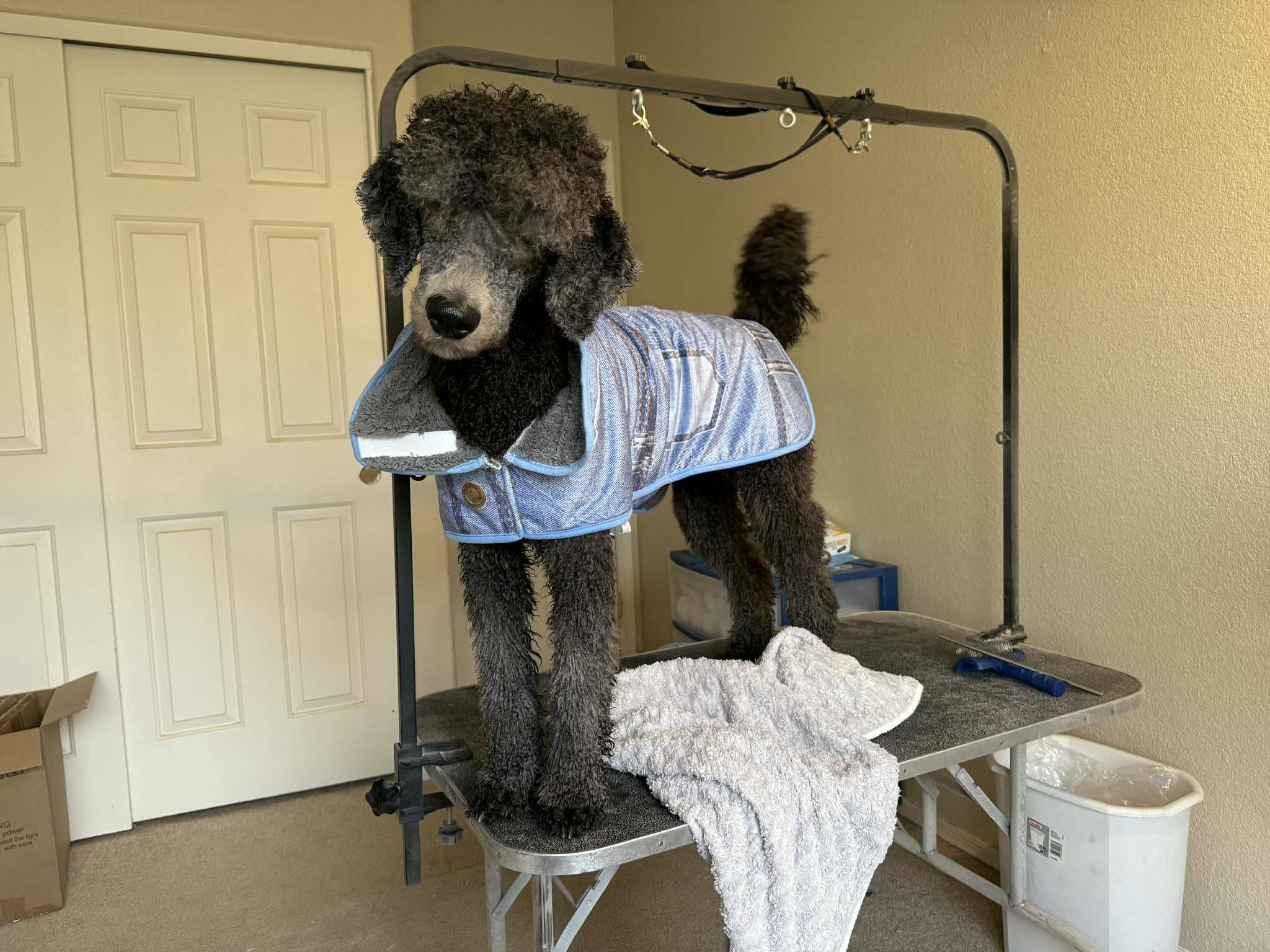
| Curly / non-shedding | Poodle, Bichon, Labradoodle | Every 4–6 weeks |
| Wire / rough coat | Terriers, Wire Fox, Lakeland | Every 8–12 weeks (hand-strip) |
| Dense, heavy double coat | Chow Chow, Samoyed, Newfoundland | Every 6–8 weeks |
These are guidelines, not fixed rules. A Poodle that lives outdoors, gets muddy walks twice a day and has an active coat will need more frequent visits than one that's mostly indoors and well-maintained at home between sessions.
Curly and non-shedding coats need more attention
If your dog doesn't shed — Poodles, Bichon Frisés, Maltese, most Doodle crosses — be especially careful about leaving too long between grooms. These coats don't drop dead hair naturally. Instead, it stays in the coat and mats from the inside out, often forming tight tangles close to the skin that you can't see from the outside until a groomer combs through.
Six weeks is usually the maximum for most Poodle-type coats. Four weeks is safer if your dog swims or plays in wet grass regularly. If you're brushing at home every two or three days, you can sometimes stretch to six or seven weeks — but inspect carefully near the ears, armpits, collar line and inner thighs, which are the most common matting spots.
A regular schedule prevents matting — and saves both you and your dog a longer, less comfortable session down the line. At that point, a gentle detangle is often not possible — the kindest option becomes a short all-over clip. Regular sessions are almost always cheaper and more comfortable for your dog than periodic emergency de-matting.
Double-coated breeds: grooming vs. shedding season
Breeds like Huskies, Border Collies and German Shepherds blow their coat twice a year — typically in spring and autumn. During these periods, a de-shedding treatment at the groomer followed by more frequent brushing at home makes a significant difference to the amount of hair around your flat.
Outside shedding season, many double-coated dogs don't need a full groom as frequently — but a regular brush-out every six to eight weeks keeps the undercoat from compressing and helps the dog regulate temperature properly in summer.
One note: shaving a double coat is generally not recommended. The two layers serve different purposes — the undercoat insulates and the outer coat protects. Shaving disrupts this and can sometimes cause the coat to grow back differently. If you're doing it because your dog seems hot in summer, a proper de-shed is usually more effective.
Short and smooth coats
Boxers, Dachshunds, Beagles and similar breeds have it relatively easy. The coat doesn't mat, doesn't need trimming and generally looks fine with occasional baths, regular nail trims and ear checks. Every two to three months is usually sufficient for a full groom, though nail trimming may need to happen more often depending on how much pavement walking your dog does.
How often should you brush at home?
The honest answer is: as often as it takes to keep your dog's coat tangle-free between visits. For curly and long-coated breeds, that may mean every two or three days. For smooth-coated breeds, once a week is often enough.
A good slicker brush and a metal comb are the two tools that matter most for home maintenance. If you can run the comb through the coat without snagging, you're in good shape. If it catches — particularly near the ears, armpits and inner legs — it's time to address those spots before they tighten further.